
Pants made to help protect against everyday leaks may not be suitable for swimming. When choosing baby pants in Kenya, look for an absorbent core for daily wear, and choose disposable swimming pants for time in the water. Each has a different purpose.
It’s natural to want your little one to feel dry and comfortable through naps, play and outings. An absorbent core takes in moisture, while a snug fit helps keep pants in place. Swimming pants are designed for water activities, not as a replacement for everyday leak protection.
This guide explains how absorbent cores work, what to look for in daily-wear pants and when disposable swimming pants may suit your baby. You’ll also find practical ways to choose a comfortable fit for your child’s routine.
Key Takeaways
- Check that waistbands and leg openings sit comfortably, without pinching or rubbing your baby’s skin.
- Choose daily-wear pants with an absorbent core for leak protection, and use disposable swimming pants for water activities.
- Before ordering online, read the shop’s delivery, return and size-exchange terms so you know what to expect.
- Compare the size guidance with your baby’s fit needs, then explore comfortable bottoms, pants, bodysuits or sets for everyday dressing.
What should I check for safety, comfort, and skin sensitivity when buying baby pants?
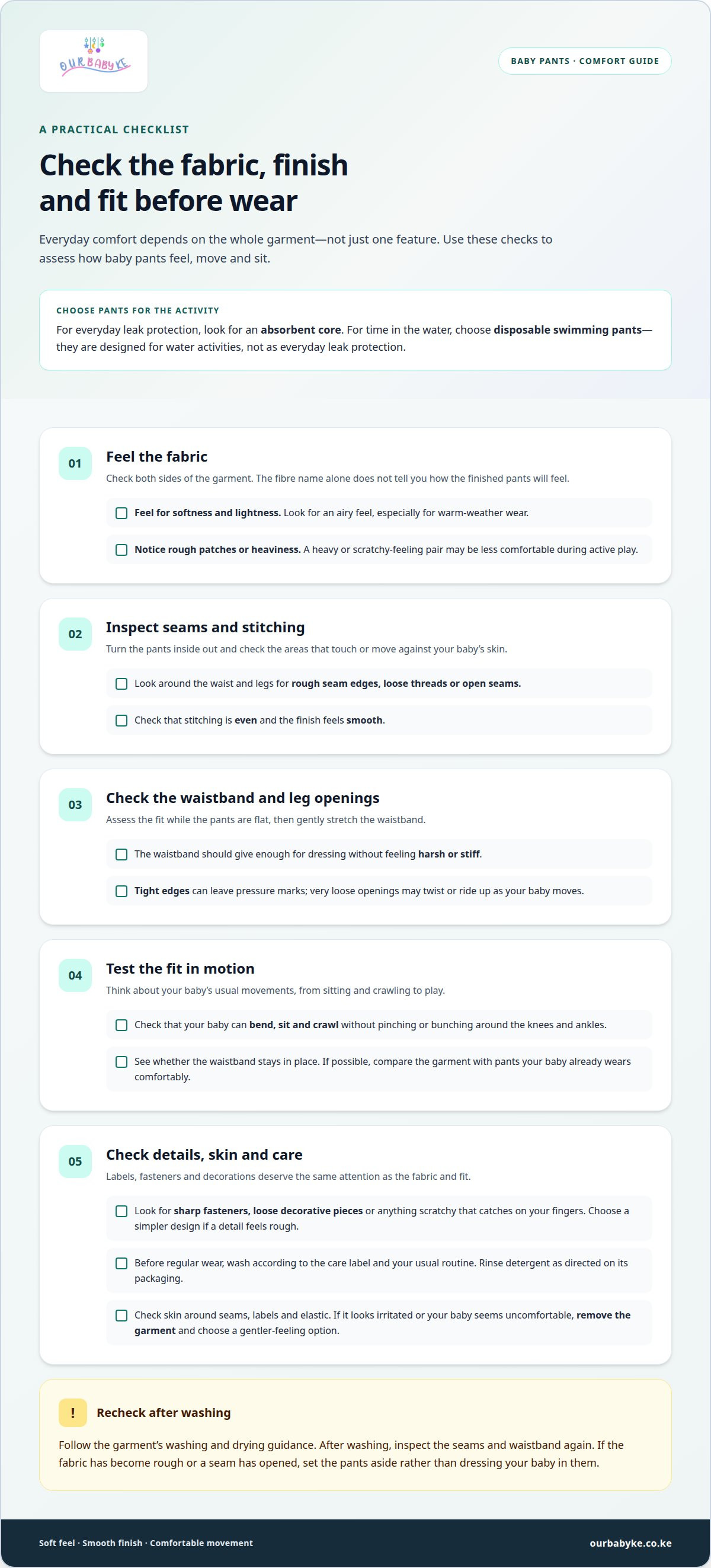
When choosing baby pants in Kenya, check the fabric, seams, waistband and leg openings. These details affect comfort during crawling, naps and changes. Turn the pants inside out and look for rough seam edges, loose threads or labels that could rub against your baby’s skin.
Start by feeling the fabric on both sides. Look for a soft, lightweight, airy feel, especially if your baby will wear the pants in warm weather. A heavy or scratchy-feeling pair may be less comfortable during an active afternoon than a softer, lighter one. The fibre name alone does not tell you how the finished garment will feel.
Check the waistband when the pants are flat, then stretch it gently. It should give enough for dressing without feeling harsh or stiff. Inspect the leg openings as well: a tight edge can leave pressure marks, while a very loose opening may twist or ride up as your baby moves. Check that the waistband and both openings have even stitching and a smooth finish.
Before dressing your baby, check for loose threads, open seams, sharp fasteners or decorative pieces that could detach. Small bows or buttons can loosen with repeated wear, so inspect them rather than judging by appearance alone. Choose a simpler design if decoration feels rough or catches on your fingers. If a piece comes loose, keep the garment away from your baby.
The fit should allow movement without fabric bunching around the knees or ankles. If possible, compare the garment with pants your baby already wears comfortably. Check whether your baby can bend, sit and crawl without the waistband sliding down. A pair that stays in place while your baby sits on the floor may work better for play than one that needs frequent adjustment.
If your baby has sensitive skin, observe how the garment feels rather than relying on guesswork. Before regular wear, wash the pants according to the care label and use the washing routine you already know suits your baby. Rinse away detergent as directed on its packaging. After dressing your baby, check the skin around seams, labels and elastic. If it looks irritated or your baby seems uncomfortable, remove the garment and choose a gentler-feeling option.
When comparing two pairs, use the same checks each time:
- Fabric: Feel the inside and outside for softness, weight and rough patches.
- Seams: Turn the pants inside out and inspect the stitching around the waist and legs.
- Fit: Check that your baby can bend and move without pinching or bunching.
- Details: Inspect labels, fasteners and decorations for loose or scratchy parts.
Care instructions matter, too. Read the label before the first wash and follow its washing and drying guidance. Avoid guessing about heat or cleaning products, as care directions vary by garment. After washing, check the seams and waistband again. If the fabric has become rough or a seam has opened, set the pants aside instead of dressing your baby in them.
Everyday comfort depends on the whole garment, not just one feature. Soft fabric can still feel awkward if the waist is stiff, and a roomy cut can rub if a seam is rough. Check each detail in good light, consider how the fit works with your baby’s usual movements, and choose the pair that feels smooth and easy to wear.
Do Kenyan shops offer delivery, returns, or size exchanges for baby pants?
Some Kenyan shops offer delivery, returns or size exchanges, but each shop sets its own terms. Before ordering baby pants online, read the delivery and returns information on that shop’s product or checkout pages. Look for the delivery areas, dispatch details, exchange conditions and any steps required after receiving your parcel. These details help you plan without assuming every shop handles orders the same way.
Delivery information should explain where an order can go and how the handover works. Check whether your location appears in the delivery area, and note whether the parcel goes to an address or collection point. For example, a buyer in Nairobi should check the stated Nairobi delivery details, while someone elsewhere in Kenya should look for their own town or area. Keep the delivery confirmation until the parcel arrives.
Before checkout, review the order summary carefully. Confirm the size, quantity, colour or design, and delivery address. A selection error matters when the pants are for a particular baby or outfit. If the summary shows the wrong size, correct it before submitting the order instead of relying on a later exchange.
Returns and exchanges are different processes. A return means sending an item back; an exchange means requesting another size or item under the shop’s stated terms. Check whether the policy covers a poor fit, an incorrect item or an item that arrives damaged. Note the required condition for returned clothing, since terms may differ for unworn items and garments that have been washed.
Use these steps when checking a shop’s policy:
- Find the terms: Read the delivery, returns and exchange information before placing your order.
- Check eligibility: Match your reason, such as a fit issue, to the policy’s stated conditions.
- Keep proof: Save your order confirmation and delivery messages until you’re satisfied.
- Follow the process: Use the instructions provided for reporting an issue or arranging an exchange.
Size exchanges depend on the shop’s process and the item’s condition. Compare the size guide with your baby’s current fit before ordering. If the guide gives measurements, use a soft tape measure and follow its directions. If it gives age ranges, treat them as a starting point and compare them with pants your baby wears comfortably. If your baby falls between listed sizes, take extra care to assess the fit before buying.
When an order arrives, inspect the parcel before removing tags or washing the pants. Compare the item with your order confirmation, then check the size label and garment condition. If something is wrong, follow the shop’s stated reporting steps promptly. Keep the packaging and order details together while reading the return or exchange instructions, so you can provide the information requested.
Delivery charges and return arrangements affect the convenience of an online order. Check the checkout details for any delivery fee and note who arranges return transport if you need an exchange. Don’t assume delivery or return shipping is free. If the policy requires the original packaging for a return, keep it until you’ve checked the size and condition.
For a straightforward purchase, choose your size, verify the delivery area and understand the shop’s exchange steps before paying. You can browse everyday baby pants while keeping those practical checks in mind.
Our Baby Ke: Bottoms
Our Baby Ke offers pants and bottoms for everyday baby dressing, with bodysuits and sets for easy outfit pairing. After checking fit and fabric, browse these clothing options to find pieces that suit your little one’s routine. Pants can be a practical choice for play or relaxed days at home, while a coordinated set brings matching pieces together. Choose what feels right for your baby’s needs and daily wardrobe. Our Baby Ke is a natural next step for parents looking for baby clothing in Kenya. Explore the available styles and select the pieces that work for your family. Visit ourbabyke.co.ke to browse the collection.
Choose the next pieces for everyday dressing
Your baby’s clothing needs can change throughout the day, from quiet time at home to active play. Let comfort and ease of movement guide your choices. A small, useful rotation can simplify everyday dressing without requiring every outfit to serve the same purpose.
As you explore baby pants in Kenya, consider how each piece fits into your little one’s routine. Pants pair easily with a favourite top, while a bodysuit offers another practical option for getting dressed. Choose pieces that suit your family and give your baby room to move comfortably.
Our Baby Ke offers pants, bottoms and bodysuits for everyday baby clothing. Browse the options at your own pace and choose what suits your little one’s wardrobe.
Explore baby clothing at Our Baby Ke, and take the next step toward a wardrobe that feels right for your family.
Frequently Asked Questions
How do I choose the right baby pants size by age or weight?
Compare the size guide with your baby’s current fit. If it gives measurements, follow its directions with a soft tape measure. If it uses age ranges, treat them as a starting point and compare them with pants your baby already wears comfortably.
What materials are best for baby pants in Kenya’s climate?
Look for fabric that feels soft, lightweight and airy, especially in warm weather. Check the finished garment by touch, since the fibre name alone does not show how comfortable it will feel.
